Downwash¶
The air a drone pushes down, and what it does to everything around it. The aerodynamics domain
builds it from what the rotors already computed (rotor/<j>/thrust, induced_velocity and
thrust_axis). It runs whenever the run has rotors and an air density; the profile’s
aerodynamics.downwash: false turns it off.
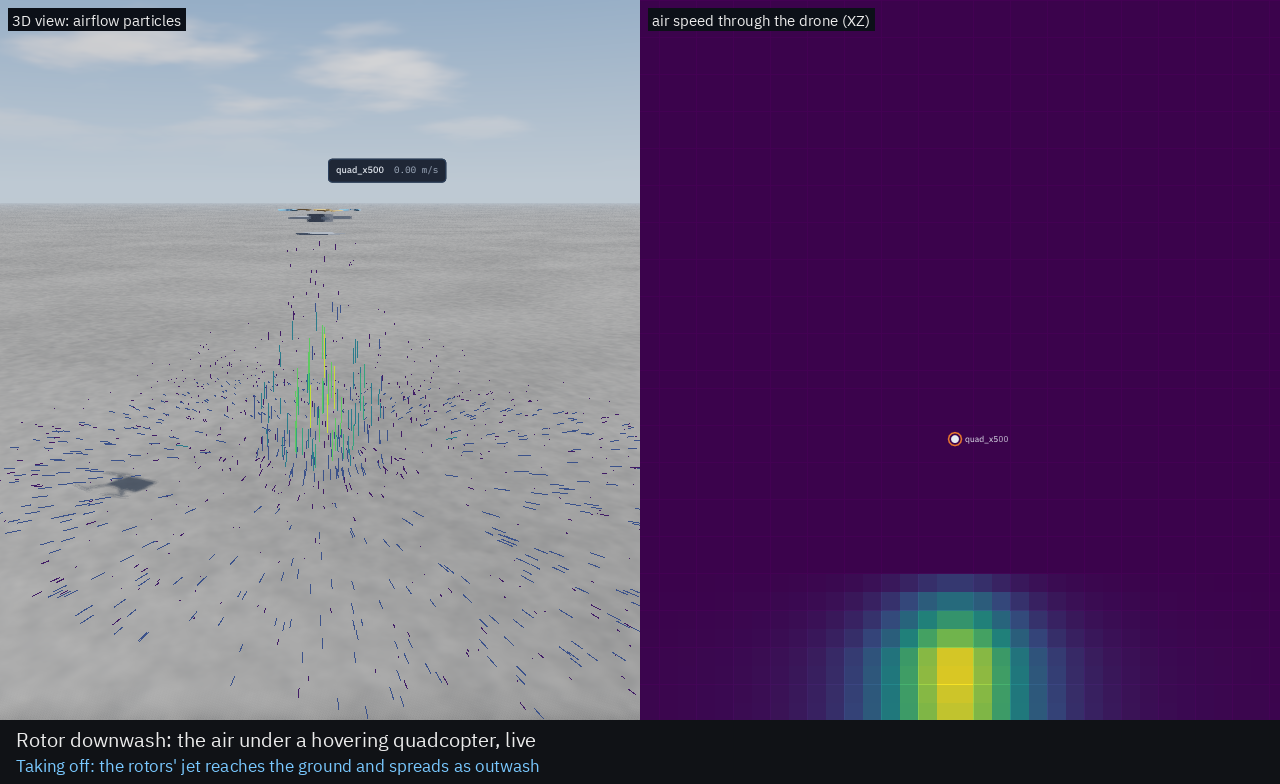
Two models are available, picked by aerodynamics.downwash_model:
Model |
What it is |
Cost |
Where |
|---|---|---|---|
fitted (the default) |
closed-form wake shapes fitted to measurements |
microseconds, CPU |
everywhere |
|
lattice Boltzmann air in a box around the drone |
about 0.75× real time, GPU |
a 3 m box; the fitted model outside it |
The fitted model¶
flowchart TB
    R["each rotor: v_i, thrust axis"] --> N["near wake: actuator disc"]
    N -->|"1.5 l to 2.5 l below"| J["merged jet<br/>Bauersfeld et al. 2024"]
    J --> G{"first surface<br/>along the axis"}
    N --> G
    G -->|ground| O["outwash ring<br/>Tanner et al. 2015"]
    G -->|roof| OR["outwash over the roof,<br/>still air under it"]
    WL["upright wall near the wake"] -->|"mirror image jet"| J
    O --> DU["dust lifted<br/>(Bagnold threshold)"]
(\(l\) is the motor-to-motor diagonal, \(R\) the rotor radius, \(v_i\) the induced velocity at the disc.)
1. Under each rotor¶
Just below a rotor the air follows momentum theory’s actuator disc. At distance \(s\) below it:
So the air goes \(v_i\) at the disc and \(2v_i\) far below, and the column narrows to \(R/\sqrt2\) to carry the same mass.
2. The merged jet¶
A few diagonals down, the four columns have become one round jet. Its centre speed and width are Bauersfeld et al.’s (2024) fit to jets measured under six drones from 0.23 to 6.3 kg:
The jet slows down and widens as it goes. The model blends the near and far wakes linearly between \(1.5\,l\) and \(2.5\,l\).
3. Wind¶
In wind or forward flight the whole wake leans with the air going past the drone (Leishman’s wake skew).
4. The ground¶
Where the jet meets the ground it turns into an outwash ring. Tanner et al. (2015, NASA) measured its peak at 1.7–1.8 R from the axis, at about 1.9 times the hover induced velocity, just above the ground. The model scales that by the speed and width of the jet that actually arrives, so a higher drone gives a weaker, wider ring.
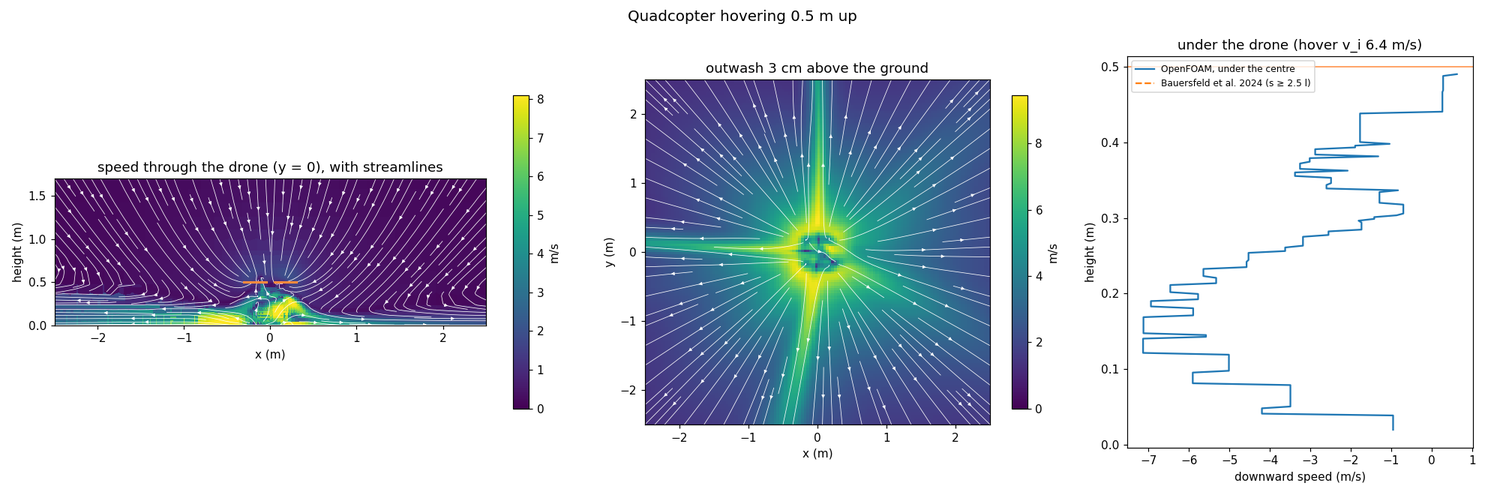
Coming down to half a metre: the outwash ring spreads wide
5. Buildings¶
The scenery’s fixed boxes are obstacles:
Roofs: the wake stops on the first face along its axis and spreads over it as outwash, up to the edges. Under it the air is still.
Walls: a wall beside the wake works as a mirror (the method of images), so the air can’t go through it. The wake hugs the wall and gets stronger there.
A wall beside the drone itself: the rotors nearest it get more air pushed down through them and the far ones less. In Lagrange’s own OpenFOAM runs, which the model is fitted to, the near rotors took about 2 % more air and the far ones about 1.3 % less. The drone tilts towards the wall unless the controller corrects it.
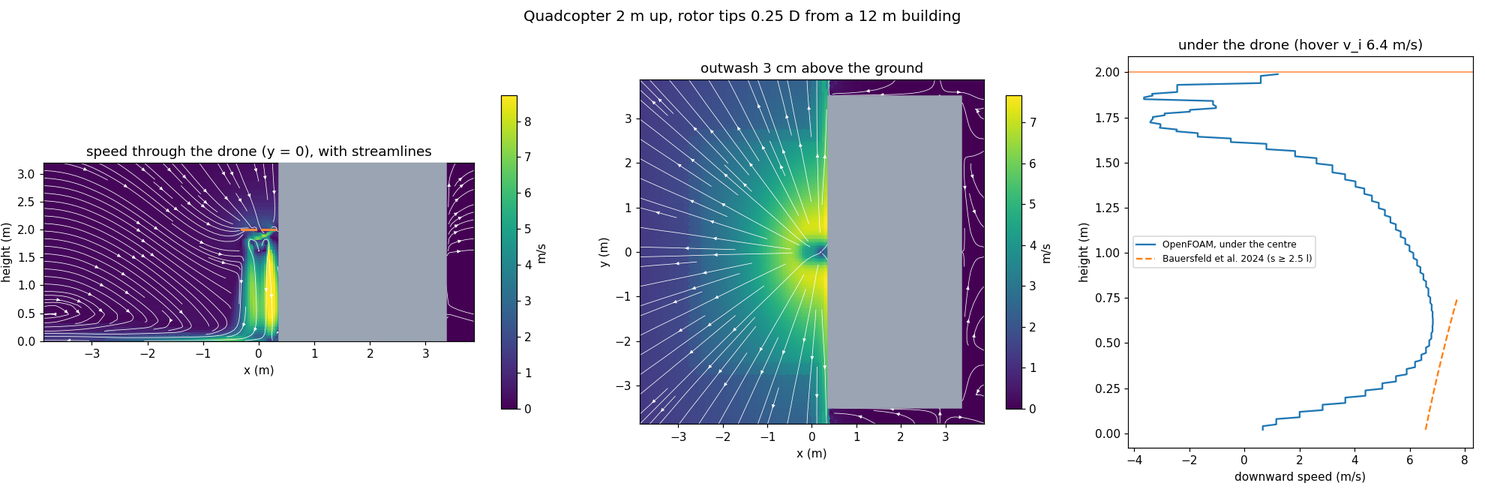
The fitted model in a run: beside the building and over its roof
6. The fountain under a low drone¶
Low over the ground, each rotor’s jet hits the ground before merging. The four outwashes meet under the frame and push it up. The model adds that push as a share of the thrust, fitted to our OpenFOAM runs of the sample at 0.5 to 2 m: 12.7 % of the thrust at one diagonal up, fading to nothing by four.
7. Who feels it¶
Other robots’ links get drag from the air.
Other robots’ rotors fly in it through
rotor/<j>/air_velocity, whichbemrotors use. This is how a drone under another loses thrust.Dust lifts from the ground where the outwash’s friction velocity passes Bagnold’s threshold, if the site gives a dust size and concentration.
A drone never feels its own wake, because its rotor data already describe isolated rotors.
The live box (lbm)¶
flowchart LR
    T["rotor thrusts"] -->|"actuator discs:<br/>a force on the cells of each disc"| L["D3Q19 lattice Boltzmann<br/>3 m box, 4 cm cells, GPU"]
    L -->|"air at each disc,<br/>less its own induced flow"| B["bem rotors"]
    B --> T
    L --> V["viewer: field aero/air_box"]
Here the air is computed rather than fitted. The box follows the drone, and each rotor is an actuator disc that pushes on the air in its cells. The jets merging, the outwash and the fountain then come out of the flow itself. Outside the box, or without a hardware GPU, the fitted model is used.
Live air: hovering, then down to half a metre
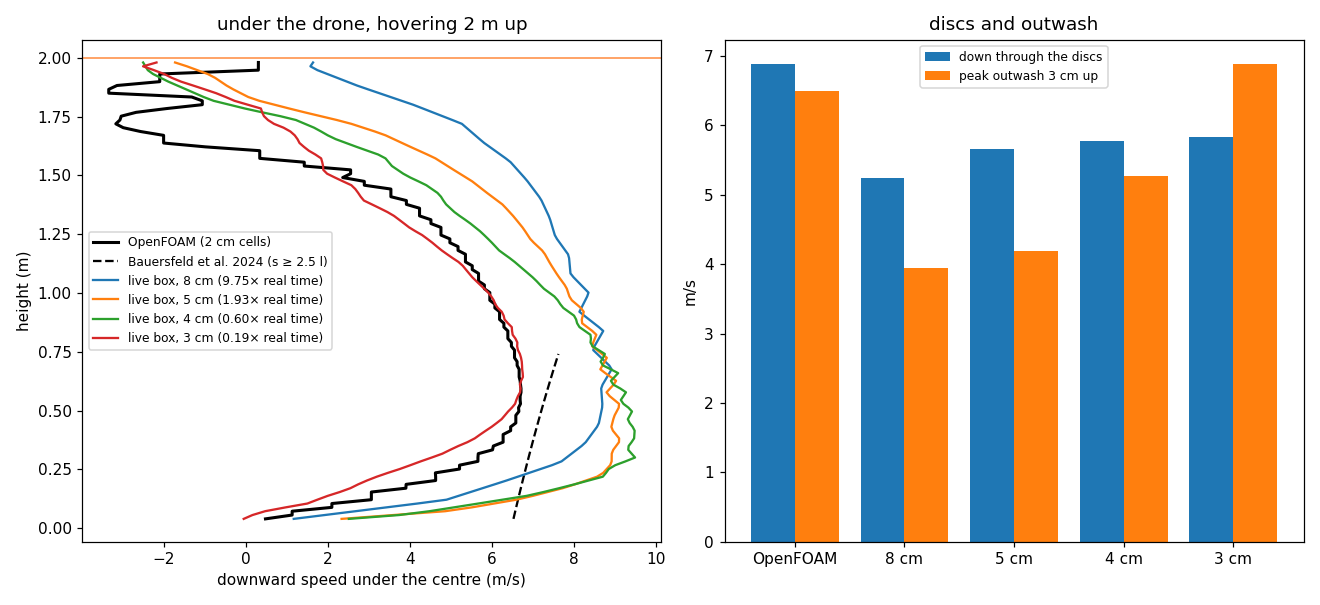
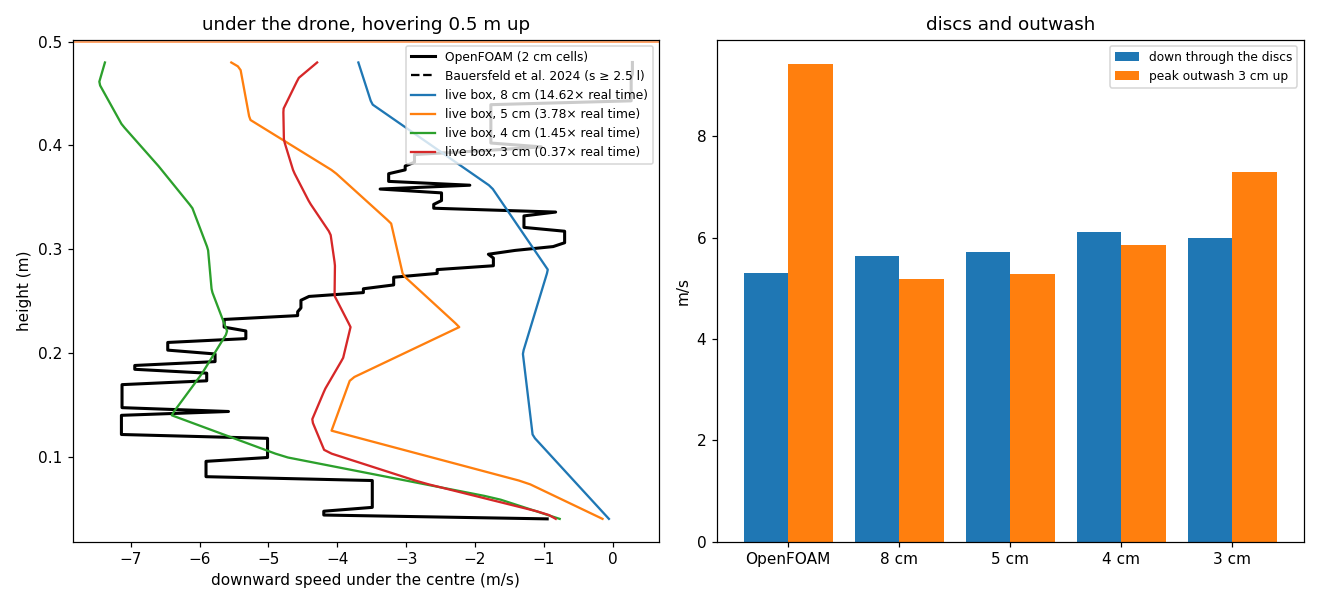
On an RTX 4060 Laptop GPU, at 4 cm cells, the box alone keeps up with real time, and a whole run of the hovering sample goes at about 0.75× real time. 3 cm cells match OpenFOAM best but run at a third of real time; 5 cm and coarser merge the jets too early to be worth it.
How far to trust it¶
Check |
Result |
Test |
|---|---|---|
Merged jet against Bauersfeld et al. 2024 |
fitted to it; its momentum carries the thrust within 5 %; our OpenFOAM centreline is about 10 % under it |
|
Outwash against Tanner et al. 2015 |
fitted at one height (1 R); between 1 and 2 R the model’s peak rises where the measurement fades |
|
A drone under a drone, against Kiran et al. 2025 (stacked Crazyflies) |
76 % of the thrust kept at 4 l, measured 65 %; 87 % at 19 l, measured 95–98 % |
|
Wall beside a drone |
fitted to our own OpenFOAM; the fade length 3.5 ± 2.7 D is weak and may reach too far |
|
Fountain |
fitted to our own OpenFOAM only, within 0.23 N; no measurement |
|
Live box against our OpenFOAM |
at 3 cm the centreline within 20 % and the outwash within 6 %; at 4 cm the outwash 19 % low; the air through the discs 15–20 % low |
|
Not modelled: inflow above the disc, swirl, unsteadiness, rotors of one drone affecting each other, and scenery other than boxes and the ground plane.
The fitted model is quasi-steady: each step it builds the wake afresh from the rotors’ thrust
and the drone’s velocity, with no memory. A wake leans back in forward flight (§3), but the air a
moving drone left behind goes still at once instead of drifting down for a few seconds, and a
sudden stop moves the whole wake at once. The live box (lbm) carries the air on from step to
step, so it has that memory, inside its 3 m box.
The viewer’s airflow particles are tracers moved through this air, sent 20 times a second in a 5.4 m box round the drone. They draw the field; they don’t push anything themselves.
The derivation, every constant and its source are in rotor_aero.md §2, the live box in §8.